
What Safety Protocols Should Linemen Follow During Emergency Storm Restoration?
The aftermath of a severe weather event in West Virginia transforms the already demanding job of a utility worker into a highly unpredictable and hazardous environment. Ice storms that coat equipment, high winds that snap transmission lines along the Allegheny Mountains, and flash floods in the steep terrain of McDowell County require an immediate, coordinated response. When the grid goes down, the pressure from the public and utility companies to restore power quickly is immense. However, prioritizing systematic safety protocols over speed is the only way to prevent catastrophic, life-altering injuries.
For West Virginia linemen working in harsh Appalachian conditions, adhering to established safety procedures is not optional; it is the difference between returning home safely and becoming a tragic statistic. The unique topography of the state, from the rugged hollows near Beckley to the busy distribution systems around Charleston and Huntington, introduces environmental hazards that compound the already lethal risks of high-voltage electrical work.
What Are the Initial Site Assessment Protocols After a Major Storm in West Virginia?
Initial site assessments require a thorough visual inspection of the work area to identify downed conductors, compromised pole structures, hazardous debris, and potential backfeed from portable generators. Crews must establish a safe perimeter, verify the structural integrity of all climbing surfaces, and conduct a detailed tailboard briefing before initiating restoration.
The landscape of West Virginia complicates this initial phase significantly. A storm restoration effort in the coalfields of Raleigh County or along the steep ridgelines in Harrison County often involves navigating heavily forested, unstable ground. Trees resting on lines create hidden mechanical tension, while saturated soil from Appalachian downpours undermines utility pole stability. During the mandatory tailboard meeting, the crew leader must identify these specific environmental hazards and communicate them clearly to the entire team.
Every member of the crew must understand their specific role and the unique hazards associated with the emergency task. Furthermore, crews must identify the nearest medical facilities, such as Charleston Area Medical Center (CAMC) or Raleigh General Hospital, and map out extraction routes in the event of an emergency. In rural areas where cellular reception is notoriously poor, satellite communication or established radio protocols must be confirmed before work begins.
Critical elements of the initial site assessment include:
- Identifying the exact location and status of all energized lines and substation equipment in the vicinity.
- Discussing the potential for localized flooding, landslides, or unstable ground conditions near the work site.
- Establishing clear communication protocols with dispatch and surrounding crews.
- Confirm that all necessary emergency equipment, including specialized rescue gear and comprehensive first aid kits, is readily accessible.
How Must Linemen Verify De-energized Lines During Grid Restoration?
Linemen must physically test every conductor using a properly rated and inspected voltage detector before treating any line as de-energized. This testing process requires a functional verification of the detector on a known live source, both immediately before and after testing the work conductor to prevent a fatal false negative.
Voltage detectors are the definitive, life-saving tool for confirming a line is entirely de-energized. A malfunctioning voltage detector that fails to alarm on an energized conductor creates a fatal illusion of safety for the lineman relying on it. During post-storm restoration, the standard grid configuration is often abnormal. Lines that should theoretically be dead might be energized due to crossed circuits, improper switching at substations in the Kanawha Valley, or illegal backfeed from residential generators.
West Virginia linemen working on Appalachian Power or Mon Power distribution systems regularly encounter 7,200-volt and higher circuits. Every single contact with a voltage detector should include the strict “test before and after” protocol required by OSHA 29 CFR 1910.269.
When utilizing voltage detectors in West Virginia’s unpredictable weather, crews should continuously watch for signs of equipment problems:
- Low battery indicators: Never ignore a low battery warning; replace batteries immediately, as detector sensitivity drops significantly with voltage.
- Physical damage: Cracked housings, damaged probes, or frayed leads can severely affect accuracy.
- Inconsistent readings: A detector that intermittently fails a self-test or gives inconsistent readings on known sources must be permanently removed from service.
- Moisture intrusion: West Virginia’s frequent rain and high humidity require particular attention to keeping sensing elements dry to prevent dangerous false readings.
What Fall Protection Standards Apply When Climbing Ice-Coated Poles?
Linemen must use 100% fall protection systems when ascending, descending, or working from elevated positions. Equipment must be visually inspected before every use for frayed webbing, damaged stitching, or deformed hardware, as extreme cold weather and ice severely impact the integrity of synthetic climbing materials.
Working at heights across West Virginia’s mountainous landscape, whether replacing poles along Route 19 near Summersville or restoring main lines in the steep terrain of McDowell County, means fall protection is every bit as important as electrical protection. A harness that fails at 40 feet produces the exact same fatal result as a direct electrical contact. West Virginia weather, ranging from severe ice storms that heavily coat equipment to summer heat that accelerates UV degradation, takes a massive toll on synthetic webbing.
Full body harnesses require meticulous inspection at multiple critical points before each use. If a shock absorber pack is deployed or visibly extended, the lanyard has arrested a fall and must be immediately destroyed. Using post-fall equipment risks catastrophic failure in the field.
When inspecting fall protection gear during storm response, check for:
- Webbing integrity: Run every strap through your bare hands, feeling for hidden cuts, abrasions, burns, or chemical damage.
- Stitching: Examine all sewn connections; pulled, cut, or frayed stitching fundamentally compromises load-bearing capacity.
- Metal hardware: D-rings must be entirely free of cracks, distortion, and corrosion, and all buckles must engage and release smoothly.
- Labels and markings: If manufacturer labels are missing, faded, or illegible, OSHA considers the unlabeled equipment definitively unfit for service.
How Can Crews Identify Worn or Defective Safety Equipment in Harsh Conditions?
Crews must systematically inspect life-saving gear for visible cracks, cuts, ozone checking, and chemical contamination. Rubber insulating gloves require daily manual inflation tests, while arc-rated clothing must be checked for tears, thinning fabric, and flammable contaminants that compromise thermal protection barriers.
The equipment that keeps linemen alive, rubber insulating gloves, fall protection harnesses, hard hats, and arc-rated clothing, degrades silently over time. A micro-tear in a Class 2 glove will not announce itself; it will simply fail at the worst possible moment, transforming a routine repair outside Morgantown into a life-altering catastrophe. Rubber insulating gloves are the absolute primary barrier between a lineman and lethal voltage.
OSHA 29 CFR 1910.137 and ASTM F496 establish mandatory electrical testing intervals for this gear. Class 00 through Class 4 gloves must be laboratory tested every six months, and the date of the last test is stamped on the glove itself. Using gloves past their test date is a serious violation that can result in citations during OSHA inspections at West Virginia worksites.
Arc-rated (AR) and flame-resistant (FR) clothing provides critical thermal protection during arc flash events, which can generate temperatures exceeding 35,000 degrees Fahrenheit. Daily inspection of FR garments should check for:
- Physical damage: Tears, rips, or holes compromise the continuous barrier that prevents catastrophic heat transfer.
- Fabric wear: Areas of thinning, especially at elbows and knees, significantly reduce the garment’s stated arc rating.
- Contamination: Flammable substances, including petroleum products, solvents, or DEET-based insect repellent, can render FR fabric completely flammable.
- Improper repairs: Patching FR clothing with non-FR material creates a dangerous weak point; all repairs must use matching FR fabric and thread.
Managing Fatigue and Mental Focus During Extended Emergency Shifts
The stress of the utility trade, isolation, long working hours, and the constant threat of lethal danger can lead to severe anxiety, Post-Traumatic Stress Disorder (PTSD), and depression. Acknowledging this hidden mental health crisis is the vital first step toward providing the necessary support for these essential workers. During a major outage affecting populated areas like Charleston, Huntington, or the Eastern Panhandle, linemen often work mandatory extended shifts lasting 16 hours or more for consecutive days.
Fatigue inevitably leads to cognitive drift, which involves persistent difficulty concentrating on the critical task at hand, short-term memory problems, or a pervasive “clouded” feeling. This makes following complex switching orders, multi-step safety procedures, or detailed troubleshooting steps challenging, time-consuming, and potentially very dangerous for the individual and the entire crew.
Trauma does not always manifest immediately after a harrowing event at a substation. It can build slowly, drastically affecting judgment, reaction times, and safety. Common symptoms of workplace trauma include intrusive memories, hypervigilance, and conscious avoidance behaviors. Linemen are meticulously trained to spot a hairline crack in a rubber glove, but spotting the signs of psychological wear is equally vital for workplace survival.
West Virginia linemen can access specific mental health resources designed for industrial workers, including HELP4WV (a 24/7 confidential crisis line), the West Virginia Peer Support Group (WVPSG), and specialized clinical centers like River Park Hospital in Huntington and Harmony Treatment Centers in Morgantown.
Handling Downed Trees and Structural Debris on Energized Lines
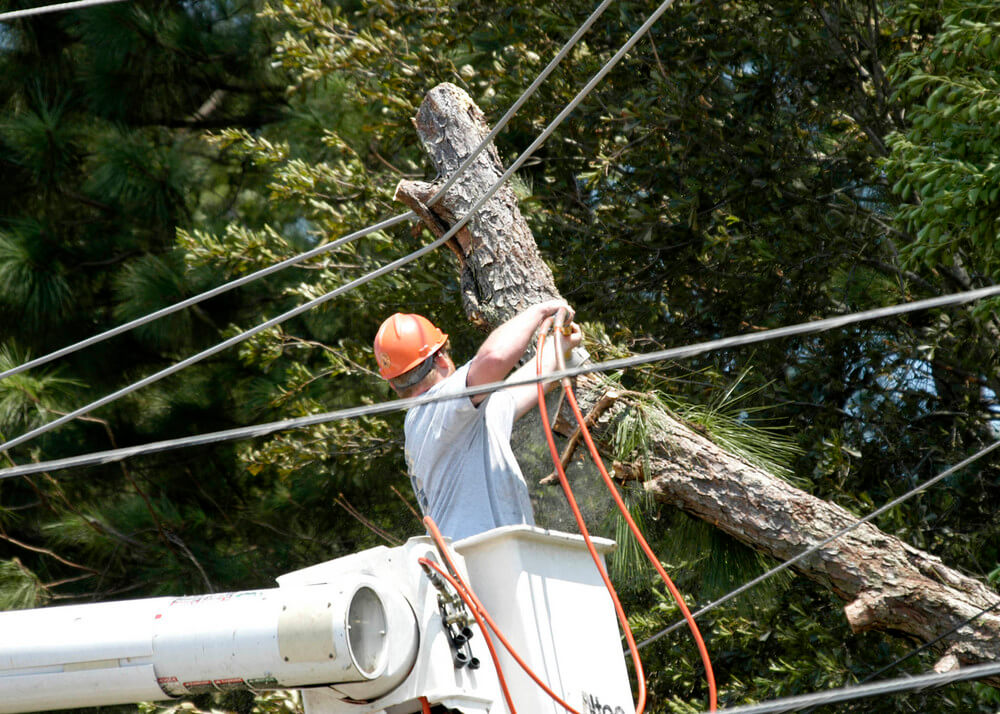
In the heavily forested regions surrounding Beckley, the New River Gorge, and the Eastern Panhandle, downed trees are one of the primary causes of storm-related outages. Crews must treat all downed lines and entangled structural debris as fully energized until proven otherwise through rigorous testing and proper grounding.
Chainsaw operation in close proximity to power lines introduces a severe dual hazard of physical laceration and electrical conductivity. When removing trees or large limbs, workers must carefully assess the mechanical tension stored in the wood and the wires. Making strategic relief cuts is necessary to prevent sudden, violent shifts in the load that can strike a worker or cause the pole to snap back.
The debris removal process requires careful crew coordination:
- Identify the exact pivot points and bind points of the fallen timber before making any chainsaw cuts.
- Establish clear drop zones and ensure all non-essential personnel and public bystanders are positioned at a safe distance.
- Use fully insulated tools and maintain the required Minimum Approach Distance until the line is visibly grounded.
- Anticipate the upward or lateral movement of the conductor once the heavy weight of the tree is removed.
Understanding Employer Responsibilities and West Virginia Legal Considerations
West Virginia operates directly under federal OSHA jurisdiction, meaning standard OSHA regulations apply to utility work throughout the entire state. Under the OSHA General Duty Clause, employers are legally required to provide a workplace free from recognized hazards that are likely to cause death or serious physical harm. Key regulations that govern lineman safety include OSHA 29 CFR 1910.269 (covering electric power generation, transmission, and distribution) and OSHA 29 CFR 1910.137 (covering electrical protective equipment).
OSHA’s Huntington Area Office and Charleston Area Office have direct jurisdiction over West Virginia worksites. Violations related to defective Personal Protective Equipment (PPE) or inadequate inspection programs can result in significant federal citations.
If worn or defective safety equipment contributes to an injury, the legal analysis extends far beyond a simple workers’ compensation claim. While West Virginia’s workers’ compensation system provides no-fault benefits for medical expenses and lost wages, it legally caps the recovery and completely eliminates compensation for pain and suffering. Importantly, workers’ compensation generally bars direct lawsuits against an employer.
However, under West Virginia law, the usual immunity that protects an employer from being sued is lifted if it can be proven that the employer knowingly and intentionally exposed you to an unsafe working condition with a “high degree of probability” of causing serious injury or death.
This is known as a “Deliberate Intent” claim. Furthermore, if an injury was caused by a defective product, such as a voltage detector that gave a false negative or a harness buckle that fractured due to improper metallurgy, the injured worker may have a valid third-party product liability claim against the equipment manufacturer or the testing laboratory that negligently certified the gear. Product liability cases in West Virginia are typically filed in circuit courts, with the Kanawha County Circuit Court in Charleston and the Cabell County Circuit Court in Huntington handling many of these complex industrial injury matters.
Contact Lineman Injury Attorney
When vital safety equipment fails during a storm restoration effort, whether due to employer negligence, manufacturer product defects, or laboratory testing errors, the consequences for West Virginia linemen and their families can be devastating. The legal team at Lineman Injury Attorney deeply understands the technical complexities of Appalachian utility work and the highly specific equipment failures that lead to serious injuries. We work alongside industry-knowledgeable consultants who can thoroughly analyze failed equipment, review laboratory testing records, and correctly identify all responsible parties.
Contact us today for a free, completely confidential consultation.


Leave a Reply
Want to join the discussion?Feel free to contribute!